
Deed Types in Shawnee County
Every deed filed with the Shawnee County Register of Deeds documents a transfer of real estate. The same office records mortgages, assignments, releases, easements, plats, surveys, liens, powers of attorney, and affidavits. Each paper type serves a different purpose. Read the instrument itself. Its title alone cannot state every reservation, exception, or limit on the interest conveyed.
| Deed type | What it does | Common use |
|---|---|---|
| Warranty deed | Conveys the stated interest with written covenants | Conventional sale |
| Quitclaim deed | Conveys whatever interest the grantor has | Family or interest cleanup |
| Trustee or executor deed | Transfers under trust or estate authority | Trust or probate transfer |
| Tax-related deed | Records a transfer from the applicable tax process | Delinquent-tax case |
| Plat or survey | Records mapped land information | Description and boundary research |
A deed conveys an interest in land. A mortgage or lien records a claim against it. A later release shows that the claim ended. One name can therefore lead to many instruments in the property records. Before treating any filing as part of a parcel's chain, sort the results. Order them by date and legal description.
Three Shawnee County Deed Searches
The Register's search choices reach real-estate records from 1856 forward through three routes. Room 108 offers free public search computers. Images can be emailed without a copy fee, or printed at 50 cents per page.
| Access | Coverage | Terms |
|---|---|---|
| Courthouse computer | 1856 to present | Free search; 50-cent paper pages |
| Fidlar Laredo | 1856 to present | Monthly plans from $50 for 250 minutes to $150 unlimited |
| Fidlar Tapestry | 1856 to present | Stated $8.95 per search |
The third-party screen labels its own fields. Coverage and in-house access stay the same. Call 785-251-4020 before travel to confirm access; the county recording access page also lists the current search routes.
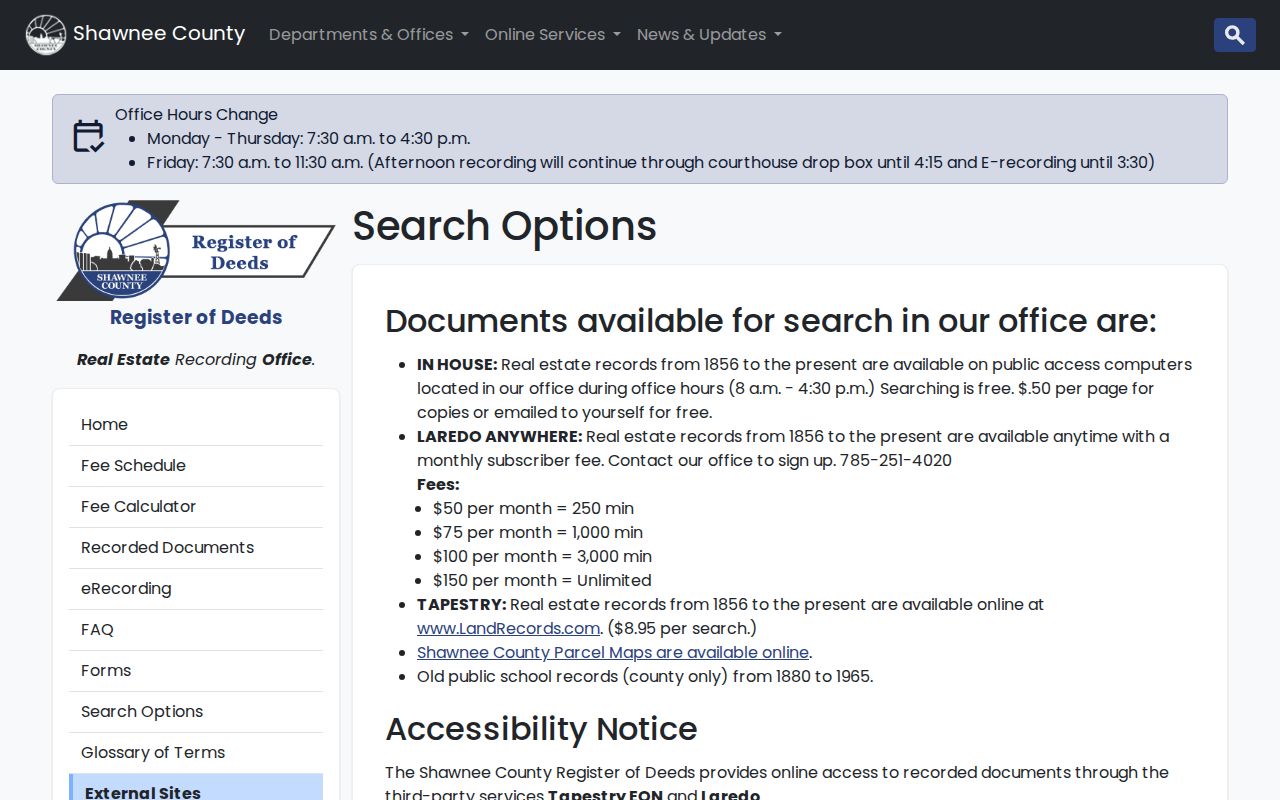
The capture confirms that remote convenience does not replace the free public-computer route.
Shawnee County Deeds Since 1856
Shawnee County's land-record story begins in the territorial period. The First Territorial Assembly created a Recorder's Office in 1855, which became the Register of Deeds in 1858. The office keeps books, maps, papers, deeds, and electronic images. Coverage runs from 1856 to the present.
Record continuity is not digital continuity. An early deed can survive in a ledger, index, image, or microfilm even when a modern query misses its terms. Start with the present parcel's legal summary. Book and page references lead into older volumes. The Kansas State Archives county holdings support work beyond the live office system.
Note: Preserve old spellings and book references when they differ from a modern parcel card.
Bridge Historic Shawnee County Deeds
An old Shawnee County deed may sit under a party name or book reference that no address search will reach. Address queries fail on the oldest volumes. Start with the newest reliable parcel card and acquisition deed. Copy everything. Keep the subdivision, block and lot, section-township-range language, exceptions, prior-instrument citation, and every spelling of the parties. Those details bridge the gap to older deed books.
The Kansas Historical Society's property-map catalog lists Shawnee County atlases and plat books from 1873, 1898, 1913, roughly 1921, and later Topeka maps. The State Archives groups county, city, township, school, and court records from the territorial era into the late twentieth century. A plat book can point to an owner, road, school, cemetery, addition, or tract. An atlas label is evidence, not a conveyance. The recorded deed chain still carries the legal transfer.
Use a source ladder when the live index stops. Move from the current deed to an older deed book or reverse index, then to a recorded plat or survey, a probate or court file, and finally an atlas or local-history source. Keep legal ownership and lived use on separate timelines. A directory may show who occupied a building while a deed names a different owner. Note the source beside each step so later work can repeat the chain without mistaking a map label for a conveyance.
Follow Shawnee County Grantors
A grantor-grantee search follows parties through Shawnee County's recorded transfers. Start from a known current deed reference. A name alone can scatter across many parcels, so the legal description and prior citation keep the chain tied to the same land.
- Find the current acquisition deed, with the current owner named as grantee.
- Read the grantor, legal description, recording date, and prior reference.
- Search that grantor as a grantee to find the earlier acquisition.
- Repeat while matching the same lot, tract, exceptions, and record links.
- Move to office books, microfilm, or archives when the electronic path stops.
- Grantor
- The party conveying the stated interest.
- Grantee
- The party receiving that interest.
- Chain of title
- The ordered sequence of transfers for one property.
- Book/page
- A volume-and-page citation for a recorded instrument.
- Instrument number
- A unique recording identifier used to retrieve a filing.
Search both sides of a transaction. Note variant spellings of each name. An estate, trust, court order, or entity can interrupt a simple person-to-person chain, so inspect the authority record rather than skipping ahead to the next familiar surname.
Link Shawnee Parcels to Deeds
The Ares parcel card supplies the starting keys. These include QuickRef, parcel ID, owner display, subdivision or section-township-range summary, instrument number, recording date, and deed book/page. One record shows the pattern. Parcel R18303 links its modern fields to instrument 2022R00256 and book/page 4363/077.
Open the full deed behind that reference. Compare its complete legal description with the short assessment text. Words carry history. Phrases such as “being the same property,” “formerly,” “except,” “replat,” and “addition” can reveal a prior filing. Words like “block” and “lot” can too. Carry those terms backward through the books. A parcel ID may change after a split or combination, while recorded references preserve the land trail.
Locating the first parcel belongs to the broader Shawnee County property search. Deed research begins once the record keys are in hand.
Rules for Recording Shawnee Deeds
Shawnee County expects certain basics before a deed can be recorded. The paper must be legible, titled, and dated. It needs proper execution, acknowledgment or witnesses, a complete legal description, and an initial reference. The filer lists the preparer and a return address. The filer then pays the required fee and any taxes due. Page one needs a 2.5-by-2.5-inch blank space at the top. A cover sheet can supply that space, though it may add a fee.
The Sales Validation Questionnaire works differently. It can travel with a deed. Yet the county does not record it and keeps it out of the public record. A questionnaire missing from a public image does not mean the deed itself is missing. Read the Register's current FAQ before submitting any document.
Watch Shawnee County Name Filings
The Register offers a free service called Fidlar Property Fraud Alert. It sends an email or phone notice whenever a document indexed under a registered name enters the Shawnee County deed records. That prompt makes a quick review of new filings much easier.
A match proves nothing by itself. Common names can fire unrelated notices. Spelling variants may call for more than one registration. An alert is a reason to pull the instrument and contact the Register. It is not evidence that a transfer was valid or fraudulent.
Shawnee County Deed Fees
Fees depend on document type and page count. The published fee schedule charges $21 for the first page of a deed, mortgage, or other writing, then $17 per added page. Town plats run $32 per page. Certification adds $13 per instrument. Mortgage releases and assignments start at $20, while lien and UCC filings carry their own amounts. Card payments add 2.5 percent.
Count every page before ordering, affidavits included. For research copies, the low-cost path is the office itself: public-computer searching is free, paper copies cost 50 cents per page, and images can be emailed with no copy fee. Recheck the official fee page before any submission, since document type and page count drive the total.
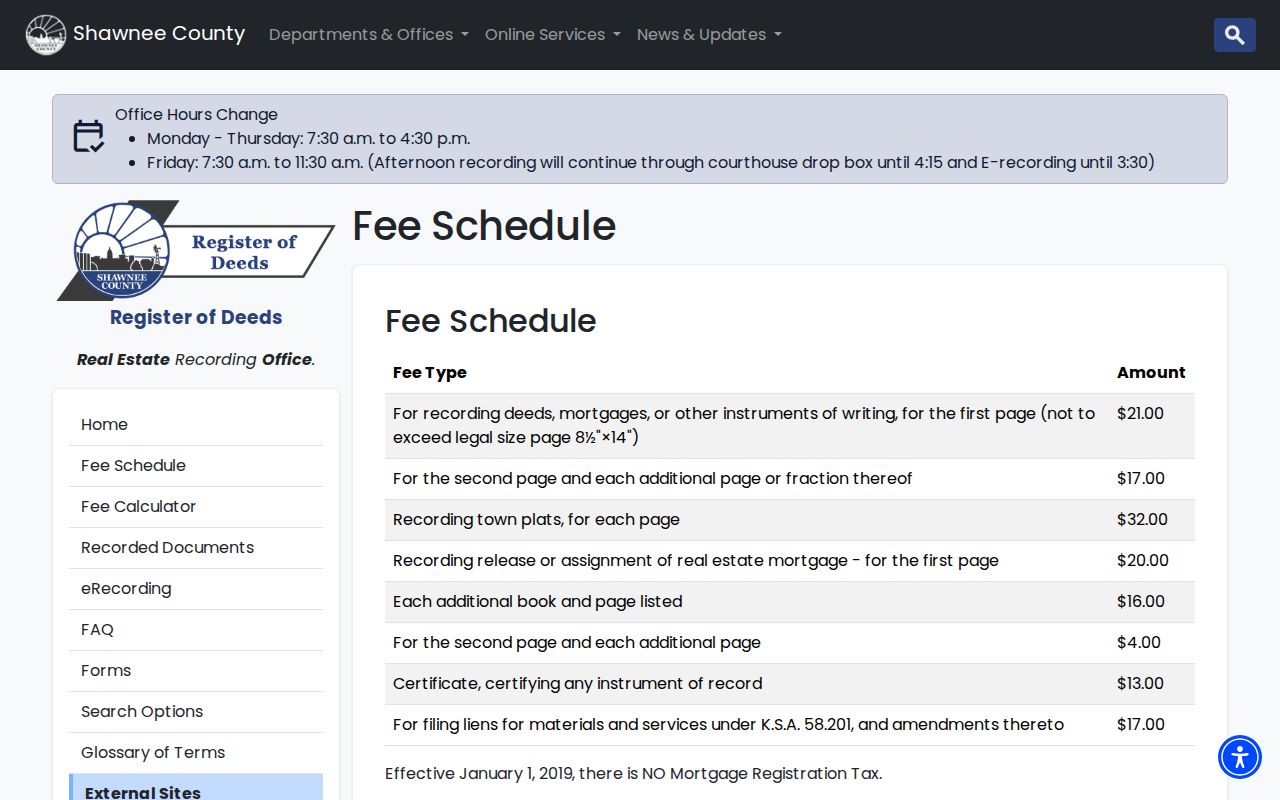
The capture helps a requester distinguish an ordinary copy from recording and certification charges.
Get a Shawnee County Deed
Pick the copy form that fits your need. A screen image suits research. A plain copy reproduces the pages, and a certified copy carries office certification. You can search remotely, use the public computer, or visit the Register at 200 SE 7th Street, Room 108, Topeka, KS 66603-3971. Posted hours run Monday through Thursday, 7:30 a.m. to 4:30 p.m. Friday hours are 7:30 a.m. to 11:30 a.m.
Give the office something precise to work from. The instrument number or book and page helps, and so do the parties' names, an approximate date, and the legal description. Staff will not run a lien or ownership-verification search for a requester. A clear citation matters. It identifies the exact deed and whether a plain image or certified instrument is needed.
Recorded, not guaranteed. Shawnee County deed records show filed instruments, but they are not a title opinion and cannot rule out unrecorded interests.