
Reconstruct Shawnee County Former Owners Transfer by Transfer
The Register of Deeds holds Shawnee County deed records reaching back to 1856. Age does not guarantee online access. Some eras need a courthouse visit. A backward chain starts with the newest recorded deed, then follows each seller to an earlier acquisition as grantee, matching the full legal description, subdivision and lot, or section-township-range wording at every step so that dates alone never carry the proof.
| Source | Years It Covers | Where Held | What It Shows |
|---|---|---|---|
| Newest transfer | Current grantee | Current deed | Instrument number or book/page |
| One step back | Current deed's grantor | That grantor's acquisition deed | Same legal description |
| Earlier digital chain | Prior grantors and grantees | Register index | Names, dates, deed citations |
| Pre-digital chain | Earlier prior owners | Deed books, microfilm, plats | Volume, page, lot, tract |
Knowing only the street address, start in Ares. Save the QuickRef, parcel ID, condensed legal summary, subdivision clues, and deed reference it returns. Then carry everything to the Register of Deeds indexes. For older rural tracts, an atlas owner name or a section-township-range description can reopen a chain that the current street address no longer follows.
Shawnee County's Three Deed-Index Access Paths
The Register's search-options page lays out three routes into the deed index. Courthouse terminals search the full 1856-present span free during office hours. Laredo sells paid monthly remote access. Tapestry covers the same broad range at a stated $8.95 per search. Printed copies in the office run 50 cents per page. Emailing an image carries no copy charge.
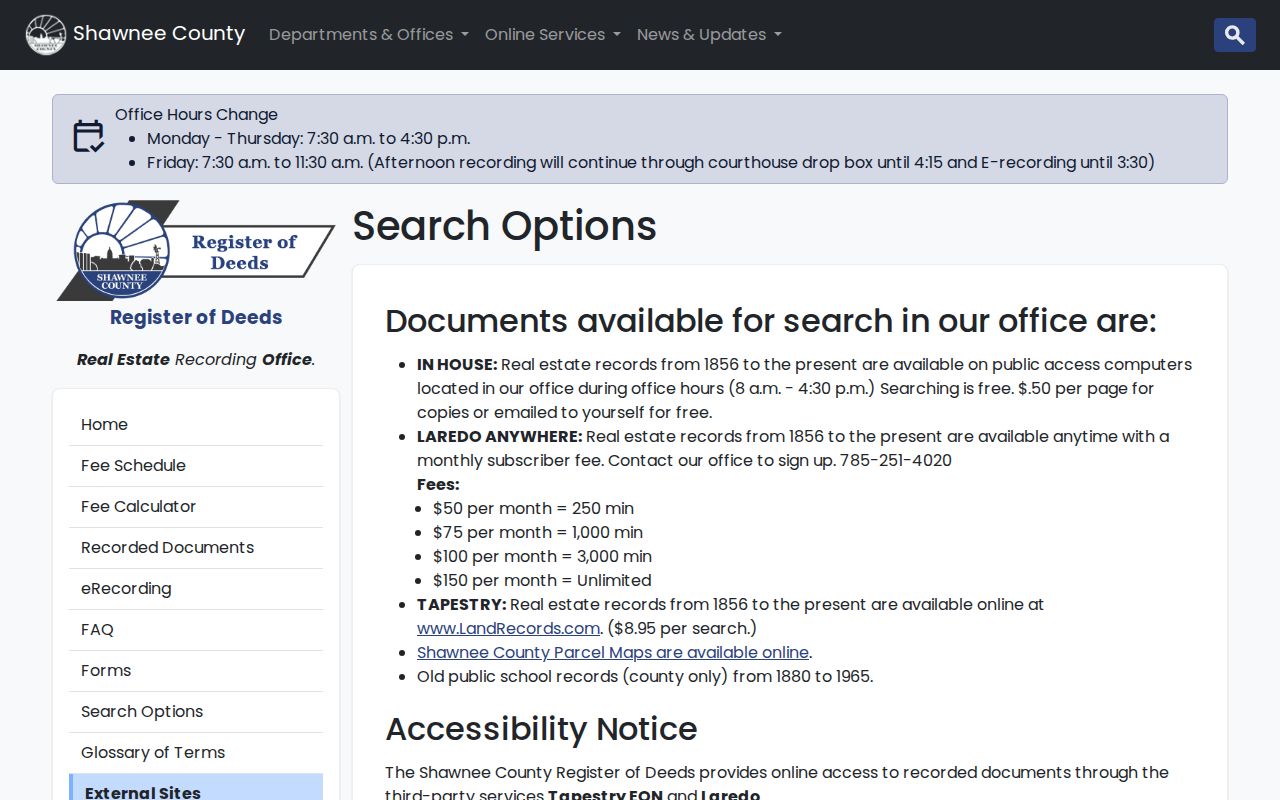
A failed online query is not a dead end. The courthouse terminal, deed books, and microfilm remain part of the Register's documented access chain for a former-owner search.
Use Shawnee County Plats to Hold the Chain to One Lot
A street address is the weakest parcel key. A recorded plat ties an old addition, block, lot, outlot, or replat to a modern form. It links that history to today's parcel number. That grip matters. It keeps the chain honest when a former owner appears under a historic street form. It also matters when one modern address covers land assembled from more than one legal tract.
The Kansas Historical Society plat-book catalog lists Shawnee County ownership maps from several eras. Dated atlases cover 1873, 1898, 1913, and about 1921. Treat atlas labels as leads. Only the deed proves title. Carry each candidate name back to a deed book and a full legal description. Do that before counting anyone as an owner of record.
Note: An atlas label gives historic context, while the recorded deed gives the conveyance evidence.
Go Back Through the Shawnee County Grantor-Grantee Chain
A reverse-index walk works backward through the parties. Each deed's grantor and grantee become the key for the next search. Record the document citation and land description before moving back, because the same name can surface in unrelated Shawnee County transfers and snap the chain.
- Find the current owner's acquisition deed, with that owner indexed as grantee.
- Read the grantor, recording date, instrument or book/page, and full legal description.
- Search that grantor as a grantee in an earlier period and verify the same land.
- Repeat until the digital route becomes incomplete, then continue through deed books and microfilm.
- Grantor
- The party who conveyed an interest.
- Grantee
- The party who received that interest.
- Chain of title
- The ordered transfer history for the same land.
- Reverse index
- An index used to locate an earlier acquisition by a later seller.
- Quitclaim and warranty deed
- Different deed forms that both require careful reading; the label alone does not settle title quality.
Older Shawnee County Owners Live Beyond Full-Text Search
The Register preserves deed books, maps, papers, and electronic images in Shawnee County. The Kansas State Archives holds still more. Its collections include Shawnee County deeds, mortgages, patents, tax rolls, school records, probate material, and court records across varying dates. A nineteenth-century deed may survive on film. Its index may still resist a modern-address search.
Plan around four items. Bring the latest confirmed deed citation. Add the exact legal description, a candidate former owner, and a date band. The Register of Deeds sits at 200 SE 7th Street, Room 108, in Topeka. Posted hours are Monday through Thursday, 7:30 a.m. to 4:30 p.m. Friday hours are 7:30 a.m. to 11:30 a.m.
The Topeka Room Adds Human Context to Prior Owners
The library's local-history collection opens more doors. Its holdings include city directories, maps, newspapers, permit indexes, cemetery resources, and microfilm. They show how an owner used an address. Street-name changes surface there too. Still, every claim must return to a deed, plat, probate file, or Shawnee County tax roll before it counts as evidence.
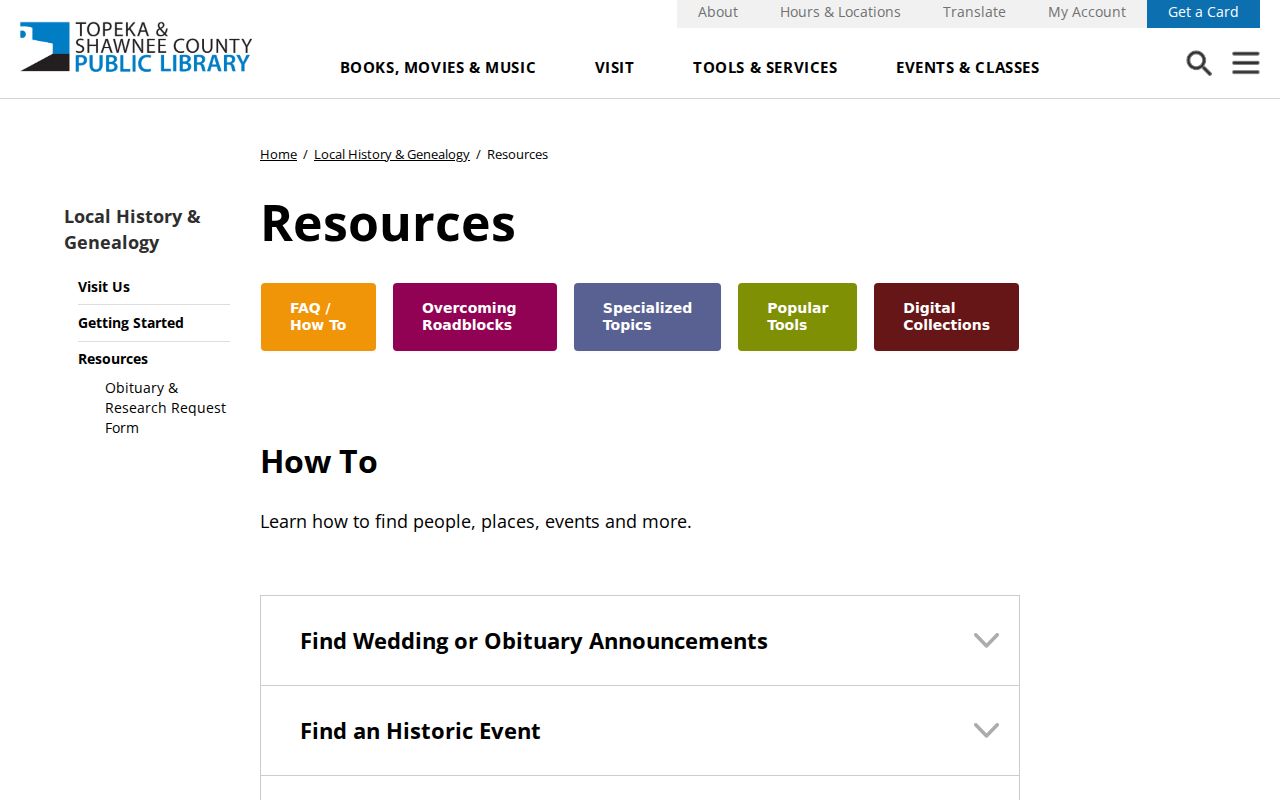
The collection works best after a deed supplies a dated name and a legal place. That narrow target makes directory and newspaper searching far more productive.
Probate Transfers Can Bend a Shawnee County Owner Chain
A tidy sale-to-sale chain can snap. Land often moved through an estate, survivorship, affidavit, or court order instead. Search probate under the deceased owner's name. Then return to the Register of Deeds. Look there for an executor's, administrator's, or personal representative's deed, an affidavit of heirship or descent, a transfer-on-death instrument, or a related filing. Restricted death certificates cannot replace this public transfer trail.
Keep case numbers, fiduciary names, legal descriptions, and recorded-document references together. They explain the change. Together those details show why a grantee shifted even when no ordinary purchase deed exists.
Keep Shawnee County's Old Parcel Identity Stable
Street names change, but land identity does not. A Shawnee County address search stalls fast when the land itself was redescribed. Anchor the tract instead. Save the parcel number and QuickRef. Then copy the subdivision, block, lot, acreage, the full section-township-range description, and any prior-instrument reference. A split, combination, replat, or correction can retire a parcel number. The legal trail stays intact. Those habits keep a tract's former owners from blurring. They also stop it from merging into a parent parcel or a neighbor's.
Match the format to the land. A platted lot keys to its addition and lot as recorded. A rural tract hangs on section, township, range, acreage, roads, and easements. A condominium follows its legal unit and declaration, never the building's street address.
Old tax rolls and city directories help you test a candidate name. Neither replaces the deed chain. A directory may name an occupant rather than the owner of record. An atlas label can span a broad holding. A tax book reflects only its own assessment date. So label every name with its source type.
Follow the book and page. An old deed may call the land the same tract as an earlier instrument. That citation is your best lead. Direct references beat name searches. Spelling, initials, married names, and indexing habits all drift over the decades. If the cited item is not online, take the citation to a courthouse terminal, a deed book, or the archives. Do not settle for a similar hit.
How Deep Shawnee County Ownership Records Reach
Shawnee County's documented Register series begins in 1856. Earlier context survives too. Federal patents, territorial materials, State Archives holdings, and historic plat books push the trail further back. One online query will not surface every former owner, though, because the records survive across formats rather than in one index.
Format limit. Shawnee County's deed record begins in 1856, but older portions may require public terminals, microfilm, deed books, plats, and archives rather than a simple web search.
Former-owner work has real uses. In Shawnee County it supports house history, estate work, and purchase diligence, but it does not authorize tracking or harassing a living person, and it is not a title opinion.