
Compare Shawnee County Property Value Types
The Ares property search places several value concepts side by side on the parcel record, and each carries its own label, valuation year, property class, and source. Read all four before comparing.
| Value | What It Is | Where |
|---|---|---|
| Appraised value | The Appraiser's estimate of probable selling price for tax purposes | Ares and Notice of Value |
| Assessed value | The class-based taxable amount derived under Kansas rules | Ares assessment fields |
| Last sale reference | A prior transaction clue with its own date and conditions | Ares sales tab and recorded deed |
| Land and improvements | The county's split of site and building components | Ares value detail and property card |
Assessment rates in Kansas depend on legal class. Residential real property is generally assessed at 11.5 percent of appraised value, while commercial and industrial property carries 25 percent and vacant lots carry 12 percent. It is a tax figure, not a sale price. Classification drives the math, so the assessed amount should never be read as a discount estimate.
See Shawnee County Assessed Value on the Parcel Detail
The official sample parcel detail for R18303 displays current and prior values beside QuickRef, parcel ID, owner, situs, legal summary, tax unit, and sales references. It makes a clear working example.
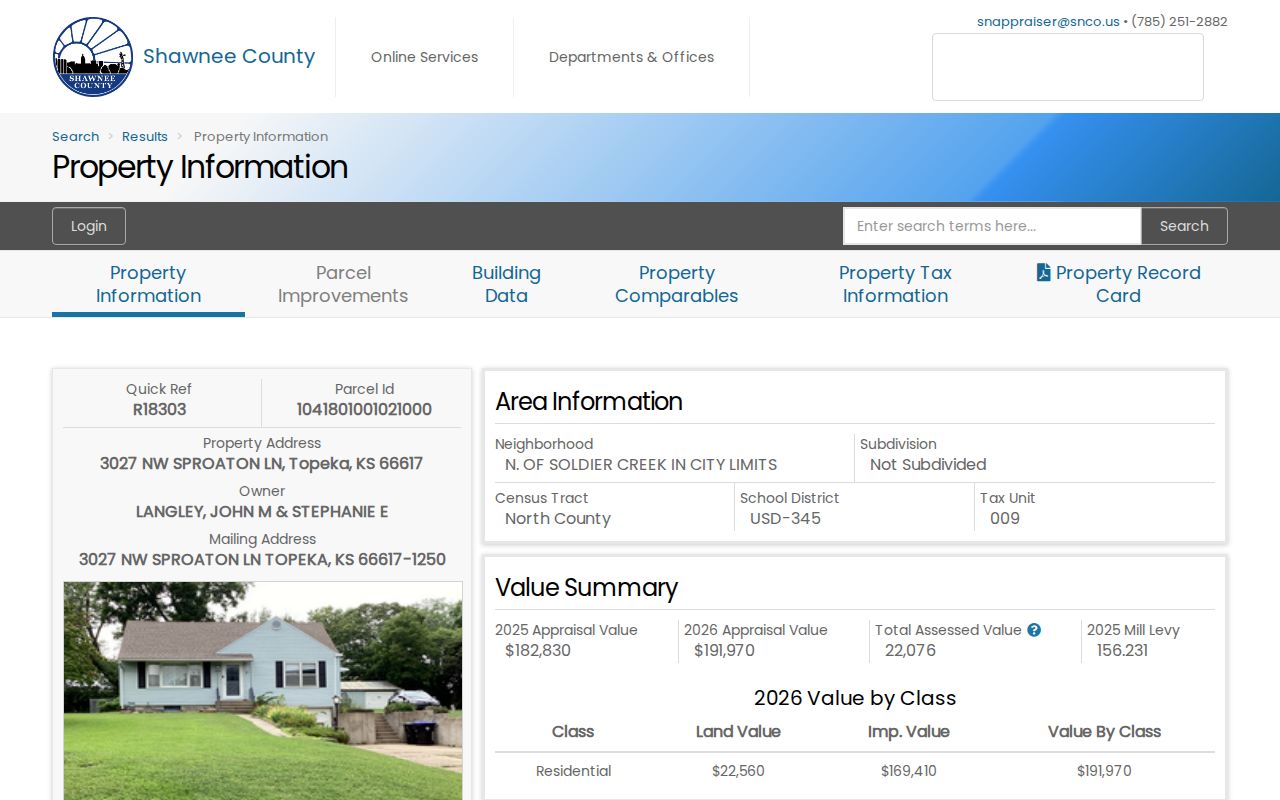
Dates and parcel identity stay visible on the record. That visibility matters when one year's value is measured against another.
Shawnee County's 2026 Market Analysis Adds Context
The County Appraiser's 2026 market analysis offers helpful context. It is not a verdict on one parcel. The report projects residential inflationary changes of roughly 3 to 10 percent depending on location, and commercial changes from flat to roughly 4 percent depending on class and type. Those ranges describe the whole county.
Parcel-level work belongs in Ares. Compare the current and prior valuation fields, the land and improvement split, the class, the property card, the comparable-sales tab, and the Notice of Value. A broad range cannot replace those dated fields. Save the year with every number.
The report cannot show whether a house changed condition, gained an improvement, lost a structure, or moved into a different class. A deed may not be an open-market sale. The parcel card, improvement details, comparable sales, and the recorded transfer answer those questions. Keep the report's publication context beside any figure drawn from it.
Note: Countywide change ranges are context only and should never be applied as an automatic increase to one property.
Classification Shapes Shawnee County Assessed Value
One appraised amount can produce two assessed amounts. The legal class makes the difference. Kansas applies 11.5 percent to residential real property, 12 percent to vacant lots, and 25 percent to commercial and industrial real property. Agricultural improvements generally use 25 percent. Agricultural land and the state's other category sit at 30 percent. The class must travel with every number.
Apply the residential rate to land in another class and you get a neat but false comparison. A demolition, new improvement, parcel split, combination, or class correction can also explain a change in assessed value. Record the class next to each figure, always.
Four terms do most of the work here. Appraised value is the county's market estimate for tax purposes, assessed value applies the legal rate, sale consideration is transaction evidence, and reassessment is the recurring update of taxable valuation.
Estimate Shawnee County Value from the Official Fields
Compare like with like. Log the year attached to every number. Also save your retrieval date, since live parcel fields and mailed notices may reflect different update points.
- Search the complete address in Ares and confirm the QuickRef, parcel ID, class, and legal summary.
- Read the appraised, assessed, land, and improvement values with their year.
- Check current and prior fields plus the comparable-sales and property-card tabs.
- Read the recorded deed or sales reference for dated transaction context, noting that not every transfer is an open-market sale.
- Valuation year
- The year to which the county estimate applies.
- Property class
- The legal category used with an assessment rate.
- Comparable sale
- A transaction the Appraiser may consider, subject to property and sale differences.
Sale Price and Shawnee County Property Value Can Diverge
A recorded price is not always market value. Family transfers, estates, trusts, and partial interests can make the consideration unlike an open-market purchase. Read the deed type, parties, date, legal description, and Ares sales reference before treating the figure as evidence.
The Register of Deeds preserves instruments from 1856 to the present through courthouse computers and paid remote services. The deed records the transaction. The Appraiser interprets market evidence for assessment.
Exemptions Change Taxable Results, Not Market Meaning
An exemption can shrink the tax bill. It does not prove a lower sale price. Keep appraised value, assessed value, exemption status, mill levy, and amount due as separate fields. The Treasurer and Clerk handle levy and collection, while the Appraiser estimates value.
For the bill, payment, exemption, or appeal procedure, use the Shawnee County property tax records guide. Those steps belong to other offices.
Get Shawnee County Value Records Beyond the Portal
Ares can go down or leave a field unexplained. The Appraiser's office is the fallback, at 1515 NW Saline in Topeka or 785-251-2882. Ask for the record card and Notice of Value. The portal also exposes improvement, building, comparables, tax, and card tabs, alongside classification and dated valuation fields.
When a specific existing record stays out of reach, the county KORA guidance offers a formal route, so identify the QuickRef, parcel ID, record year, and field. A precise request gets a precise record.
Compare Shawnee County Value Years on Equal Terms
Compare Shawnee County figures on equal footing. Lock the parcel down first: same QuickRef, same parcel number, same class. Then match appraised value to appraised value and assessed value to assessed value. Note the valuation year beside each. A raw percentage can mislead even when both numbers were copied perfectly. Land area, improvements, class, or parcel configuration may have shifted between the two years.
The Ares property card helps here. Its improvement tabs show whether the physical record changed. The sales and comparables tabs supply market evidence the Appraiser selected for assessment work. A comparable still is not the subject parcel. Location, date, size, use, quality, and condition all drive differences. Keep the source and date beside every figure you quote.
For the county's current appraisal and appeal posture, the annual Notice of Value is the strongest dated word. Set its prior and current figures against the live parcel page. When they disagree, ask the Appraiser which version and date control instead of blending the two. Treat the county's market-analysis range as general context only.
Handle any sale reference with the same discipline. Check whether the deed conveyed the full property and whether the transaction qualifies as open-market evidence. Family transfers, estate transfers, trust transfers, and partial-interest deals can all record a figure. That figure may behave nothing like a typical sale. The number belongs in the record either way. Its meaning, though, depends on the instrument behind it.
Understand What Shawnee County Property Value Cannot Prove
The Appraiser's estimate is a mass appraisal. It projects the most probable selling price for tax purposes across thousands of parcels, and a single sale can reflect condition, timing, financing, or legal interests that no model captures. A Shawnee County parcel value also proves nothing about boundaries, ownership, code compliance, or clear title. Read it as a tax figure, not a title opinion.
Value is not price. A Shawnee County assessed value is a tax figure, not a promise of what the property will sell for and not a private appraisal.